Procession as a trial and spiritual feat: the road from Kamianets to Pochaiv
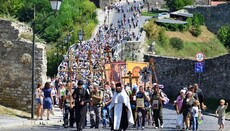
Many can no longer imagine their lives without these six summer days, during which pilgrims cover 250 kilometers on foot. This procession is one of the largest and probably one of the oldest in our country.
The first recorded mention of it dates back to 1832, shortly after the Pochaiv Lavra returned from the Unia to the Orthodox Church. At that time, a blind girl named Anna Akimchukova came to the Lavra with her grandmother and regained her sight after fervent prayer before the Pochaiv Icon of the Mother of God. In memory of this wondrous event, Archbishop Innokentiy, the Lavra’s sacred archimandrite, instituted the weekly communal reading of an akathist before the miraculous icon. Each year, people began prayerfully retracing the path taken by little Anya and her grandmother – walking long kilometers to the Mother of God in remembrance of the miracle.
Even during the harsh Soviet years, the procession continued. People walked at night in small groups of three to five. As recently as the early 2000s, among the thousands of pilgrims were people who had once made the journey in those tiny groups. Today, the Pochaiv procession is a major event bringing together not only people from across Ukraine but Orthodox Christians from around the world.
So what happens along the road from Kamianets-Podilskyi to Pochaiv? What is the journey actually like? Why do people undertake it? Archpriest Andriy Sosiuk, a cleric of the Kamianets-Podilskyi Eparchy, answered these questions.
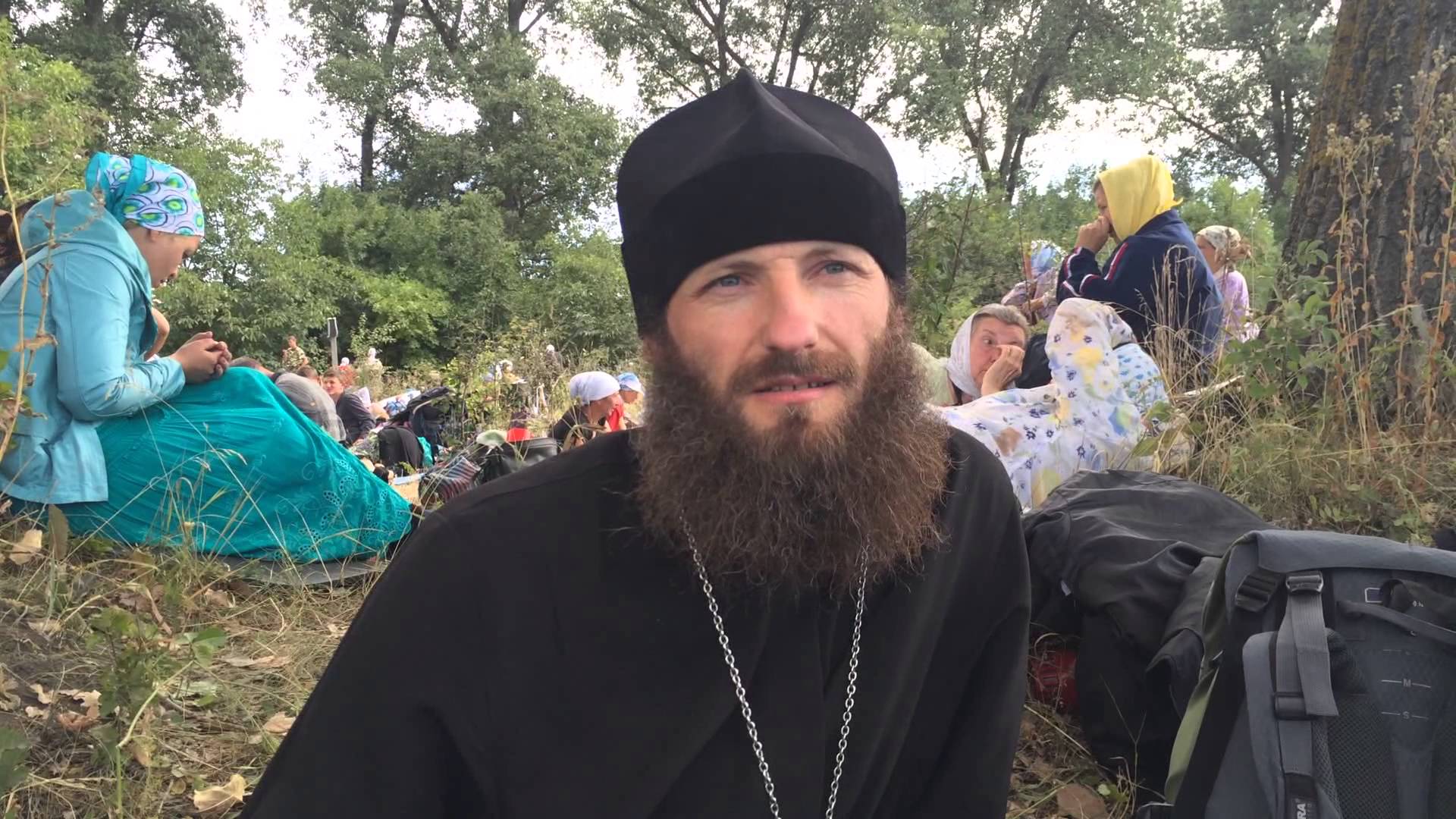
– What is a procession from a spiritual point of view?
– Spiritually speaking, a procession is first and foremost prayer. If we look back through history, processions often arose in response to catastrophes – natural disasters, epidemics, disease, wars. Believers knew and understood that through a procession the situation could be changed for the better, that things could be set right. After all, it is communal prayer: believers gather with icons, prayers and hymns, in repentance, and walk a certain distance together, even if it is not very far.
Such acts always brought positive results for a people, a city, or even an entire country. That is why the tradition of processions is so ancient and so powerful. Even nonbelievers, when they see these huge processions of people walking and praying – and I can personally attest to this – stop, get out of their cars, take pictures, and sincerely marvel at the grandeur of what they are witnessing. It is not simply a public profession of faith in Christ – it is a proclamation of Christ.
At such moments, people have an opportunity to reflect on what they see and ask themselves: perhaps there is something I can do to change my own life for the better? Of course, we are talking about the spiritual dimension of human life, and very often it is precisely a procession that provides the first impulse toward future change.
Let me say it again: a procession is first and foremost prayer. It is a struggle against one’s passions, because by setting out on a procession, a person truly gives up many things. This is especially true of the procession to the Pochaiv Lavra, which lasts an entire week. Often, a person does not know where he will wash or where he will spend the night.
If night catches you somewhere in a field, you simply drop wherever you can – in a tent in the field, somewhere beside a church. There is only one thing left to do: pray and humble yourself. It becomes a test of faith, a test of human weakness – especially in the spiritual sense. Why spiritual? Because on the second or third day, all of a person’s problems, passions, and sins begin to surface. If a person is properly attuned spiritually, he immediately notices these shortcomings and tries to correct them. That is why, spiritually speaking, a procession is so important both for the individual and for society and the state.
– Father Andriy, how many times have you made this procession?
– This will be my eighth.
– And as the senior priest leading the column?
– This is the eighth year that I have received the bishop’s blessing to lead the column.
– Would it be easy for you simply not to go to Pochaiv?
– I have asked myself that question more than once. People around me sometimes tease me: find someone to replace you – surely you’re not the only person who can go?
And it really is not easy. It is genuinely hard – physically, psychologically, emotionally. I don’t know, it is hard in every possible way. But only at first. By now, I probably couldn’t not go to Pochaiv unless... well, I don’t even want to talk about that.
I don’t think there has been a single day when I haven’t thought about the procession. Ever since I first went eight years ago, it has constantly been on my mind. So many people take part in our procession. You go to Kyiv, walk into the Lavra – “Father!” And there are our fellow pilgrims. We went to Chernivtsi – again, people from the procession.
We even went to the mountains in Zakarpattia and met pilgrims there. And immediately we start talking about the procession – memories, plans for the next one. We talk, discuss things, take pictures together. It has become something so close to us that it really feels like a family, especially among those who have been walking for years. Everyone waits for the procession. We have barely arrived at the Lavra before we start waiting for the next one.
There is an indescribable feeling when the entire column of thousands drops to its knees before the holy gates of the Pochaiv Lavra after so many exhausting days on the road and, after a prayer to the Most Holy Theotokos, gradually seems to dissolve into the monastery grounds. So yes, I probably could no longer imagine not going to Pochaiv.
– What frame of mind do people bring to the procession?
– Everyone comes differently, with a different disposition. Experienced pilgrims who have done this before know that the first and foremost thing is prayer. Everyone comes with their own difficulties and problems. Some make a promise to God; others ask Him for something. Some ask for a blessing – for marriage, for work. Others come asking for healing for their children, themselves, or their relatives.
And something especially relevant now: we all walk praying for peace in our country. People’s dispositions depend on many things – after all, there are many thousands of pilgrims. Someone bumps into you here, someone steps on your foot there...
And then the passions begin to show themselves. But if a person truly believes, he recognizes what is happening and tries to control himself. Everyone comes carrying something of their own. Yet everyone is united by a single impulse of prayer and repentance, and that bears good fruit.
For people coming for the first time, the first few days are bewildering. They cannot understand where they have ended up – everything is unfamiliar. Very often, such people even overtake the head of the column – where the icons, cross, banners, and senior priest are supposed to lead – and that is a problem on the first day. But by the second or third day, they realize there is no point in rushing. Sometimes by then they can barely walk normally because they exhausted themselves running ahead during the first few days.
And then they simply humble themselves. At first, of course, they complain. Sometimes they even become resentful. But by the end, everything is completely different – everyone is happy with everything. And when the pilgrims finally see the Lavra... There is simply no way to describe the atmosphere, those feelings. You have to experience it yourself. Of course, no one should be forced to go. But once a person has walked this road and experienced it all, he will want to return again and again, to walk the entire way from Kamianets-Podilskyi to Pochaiv. This procession has an enormously positive effect on a person – on his soul, his faith, on the whole person.
They say that if you really want to know someone, live with them for three days, travel somewhere together, see them outside their usual surroundings. It is the same on a procession – by the third day, you can see what a person is really made of.
– How is the procession organized? Is there a set schedule? How does the day begin and how does the journey unfold?
– Over these eight years, we have indeed developed a set order and schedule. We know very precisely where we have to be and at what time – practically down to the minute. Many people join the procession along the way. Some cannot make the entire journey from beginning to end, so they either finish their pilgrimage earlier or join us later.
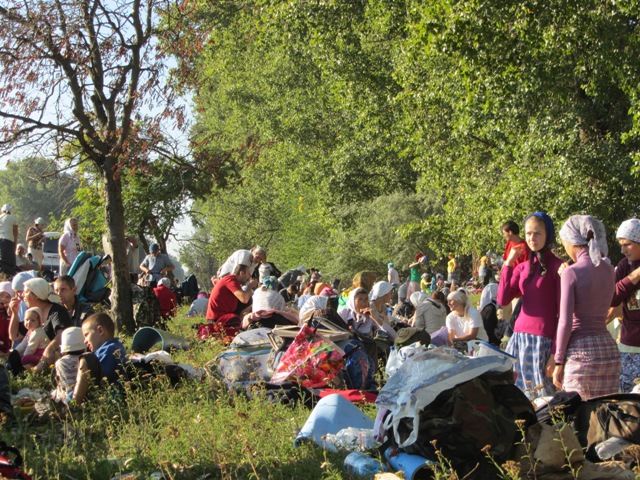
There is a schedule for rest stops, especially since people usually come to these places to feed the pilgrims. I sometimes compare the procession to an enormous train carrying thousands of people. It has a precise timetable and knows exactly where it will stop – where there will be a rest break, a moleben, a memorial service, or an overnight stay.
Here is roughly what a typical day looks like. It begins before dawn. At 4:00 a.m., everyone gathers by the icons and morning prayers are read. Of course, not everyone comes, but the rule is that everyone should have completed their morning prayers by 4:30 because at half past four the column sets off for the day.
– Why so early?
– First, it is easier to walk in the morning before the sun gets too high. There are fewer cars, and part of our route runs along a highway. Second, we need to leave early so we can reach the next overnight stop earlier. There have been times when the column arrived after dark, and it was quite difficult for people to settle in for the night. You have this huge mass of people who need to pitch tents, eat something, wash up, and get themselves organized. So it is very important to reach the overnight stop while there is still daylight. We usually arrive at around eight in the evening. That leaves another hour of daylight, giving people time to settle in and get proper rest before the next day.
Toward the end of the journey, the column arrives earlier because the distances become shorter, unlike the first few days when we cover up to 40 kilometers. Along the way, we serve a litia at every cemetery and sing “Before Thy Cross...” at roadside crosses.
– How should people walk in the column?
– The main thing is to stay together with the other pilgrims and remain close to the icons. You should not run ahead of them, but neither should you fall too far behind. Let me stress this again: do not walk or run ahead of the icons!
– Which part of the journey is the hardest for pilgrims?
– I think the hardest days – the turning point, you might say – are the third day and, for some people, the second. Those are the longest stretches and the longest marches. The route runs along the highway, it is often very hot, and then there is the asphalt and the traffic. It is extremely difficult. This is when we make our 40-kilometer forced march. It really is very hard – I feel it myself. An inner struggle begins. And it is not so much physical as internal, psychological, spiritual. There can be so many emotions.
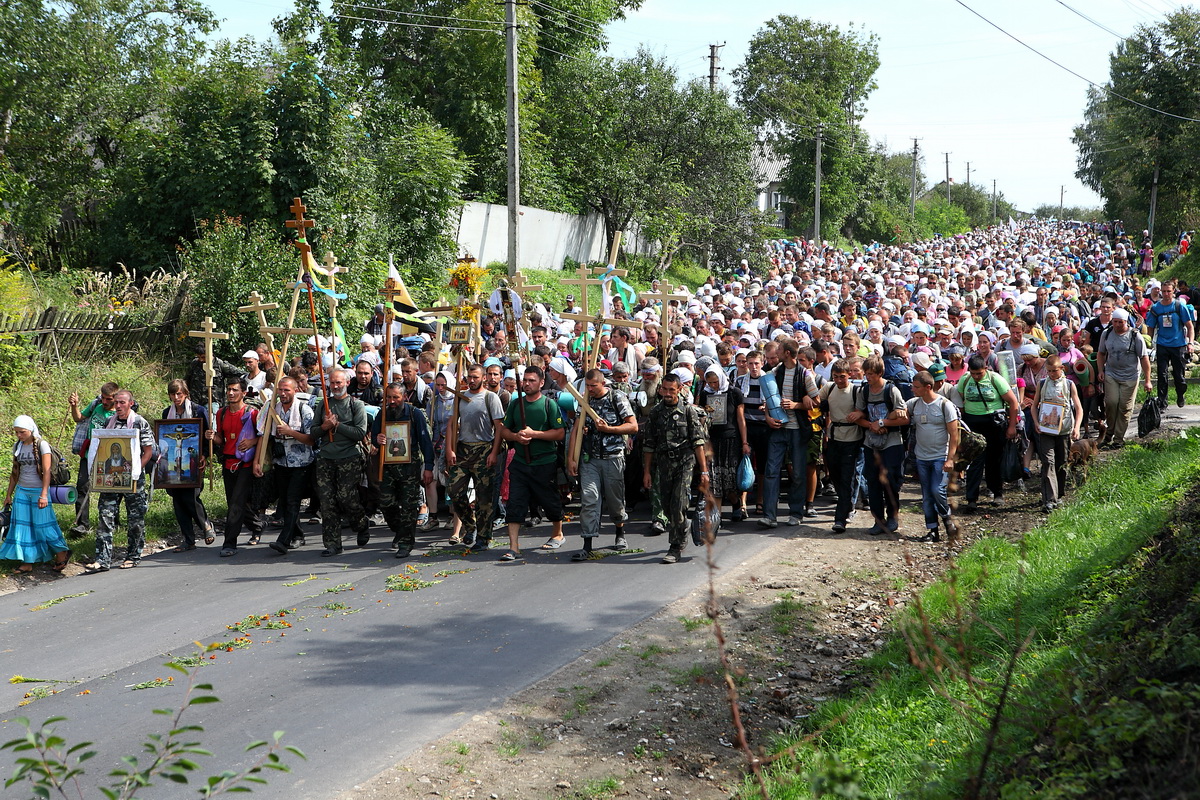
There may be despair, despondency, even grumbling. But you have to live through those moments, and then a person begins to grow spiritually. The procession strips away everything superfluous and reveals what is real. Self-confidence falls away, self-centered expectations disappear, the initial adrenaline is gone, physical strength is exhausted, and, in the words of the Apostle Paul, “grace comes when both our faith and our strength are failing.” It is then that grace begins to make up for our weakness and gives us the strength to keep walking.
I think this is precisely why we go on the procession – for that grace that comes at those moments. A person reaches a certain threshold where it seems that this is it: there is no way to go any farther. “I can’t. I won’t take another step.” And that is when the Lord strengthens you, carries you in His arms, carries you on wings. But first you have to make it through those first three days.
– Father, what kind of people go to Pochaiv – young people, the elderly? Who are they?
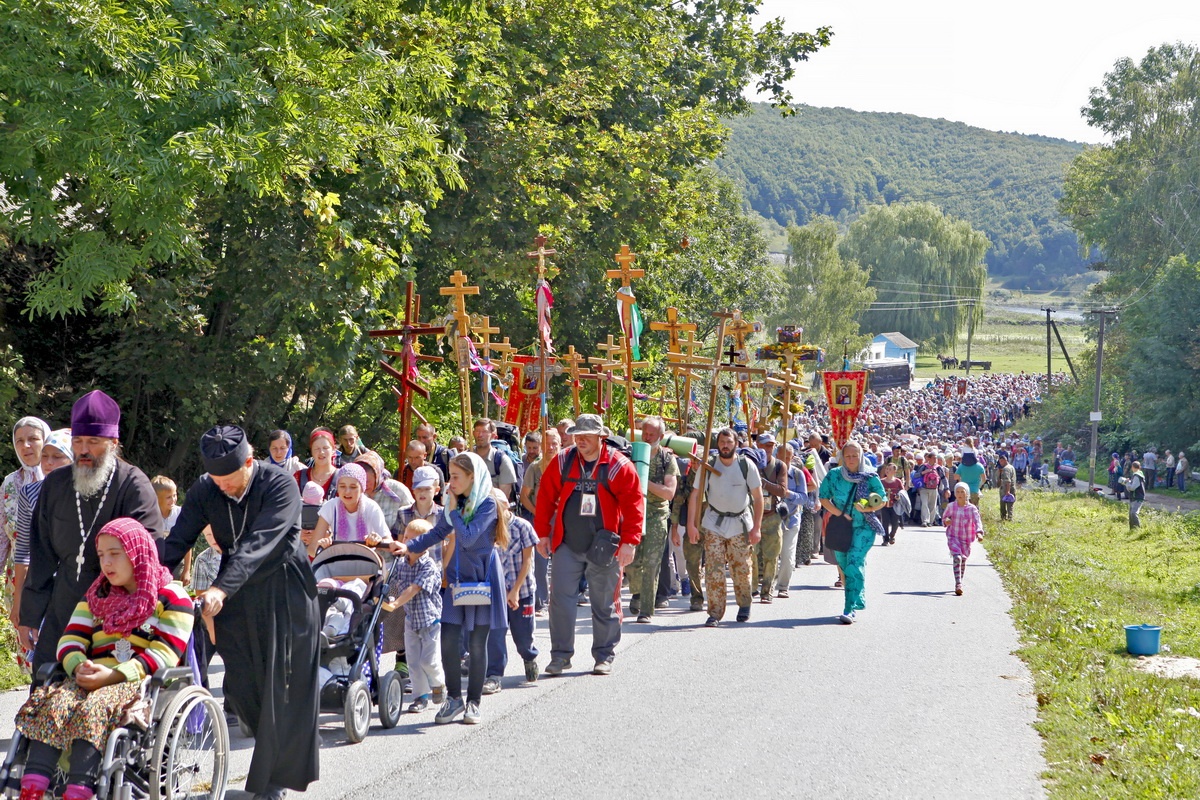
– Some years you could say the ages range from zero to one hundred! The Pochaiv monks sometimes ask us to find out who the youngest pilgrim is and who the oldest is. One year, we discovered that the youngest was a two-month-old baby – although there are also many pregnant mothers walking in the procession, so their babies are participants too!
That year, the oldest was a priest who was 85, while some of the grandmothers were 87 or 88. Of course, they could not walk every single kilometer and were sometimes given rides, but the fact remains that they made it all the way to Pochaiv and entered the Lavra together with the column. There are a great many young people and elderly people. Whole families come, including parents pushing children in strollers.
– And where do they come from?
– From all over Ukraine! From Kyiv, the east, central Ukraine, the west, Chernihiv Region, Zaporizhzhia Region, the south. From every single region. And from other countries – Poland, Moldova, Romania, Russia, Belarus. Last year there were people from France and England. I know that some English pilgrims from London specifically arranged their vacations so they could take part in the Pochaiv procession. Many pilgrims try to schedule their vacations for the time of the procession so they can make the journey and pray together all the way to Pochaiv.
– In this particular case, could taking part in a procession actually harm someone spiritually? A person might think: “Look how far I walked, how much I endured, I made it all the way to Pochaiv – what an achievement!” How can that be avoided?
– I have not personally encountered that, but such people could be reminded of the Lord’s words about fasting: we should not condemn those who do not fast. The same applies here. We should not condemn people who do not take part in the procession, and those who do should not become proud, like the Pharisees who sprinkled ashes on their heads and put on mournful faces when they fasted. There is no place for pride. Instead, we should humbly and penitently thank God for helping us accomplish this spiritual feat and reach Pochaiv. I think the most important thing is for a person to have humility – so that this procession, this feat of labor and prayer, may give every participant more patience, love, faith, and grace.
– What would you wish for the pilgrims preparing to walk from Kamianets-Podilskyi to Pochaiv this year?
– There are many things I could wish for them: don’t forget comfortable shoes, a tent, a sleeping bag, a camping mat. All of that is obvious and necessary, but those are the practical details.
The most important thing is not to forget your prayer book and to prepare yourself for prayer. That is extremely important. A procession is not a hiking trip – first and foremost, it is prayer. You need to set out with the desire to become a better person. That is very important. I would wish them the same thing we wish for someone going to confession – to change for the better.
So that is the one thing I can wish for you: become better. Make promises to yourselves about what you need to change. If you smoke – quit smoking. If you are dependent on something else – set yourself the task of breaking that dependence. In this way, cleanse your soul and heart and draw closer to God.
Many have already packed their bags, bought their tickets, and filled their cars with gas. Many are waiting for the feast of the Transfiguration of the Lord, when the procession will set out from Kamianets-Podilskyi toward the Pochaiv Lavra. Some will be going for the first time; others have made the journey before. But everyone needs to remember one thing: a procession is prayer and repentance. It is not a political demonstration. There are no political banners or portraits. At the head of the procession are icons, crosses, and church banners. Its purpose is prayer and bringing people together through prayer. Nothing else belongs there.
P.S. In recent years, because of the large number of participants – according to approximate estimates, between 15,000 and 20,000 believers took part last year – the procession has been accompanied by buses and ambulances. This allows those who are physically frail – elderly people, the sick, and pregnant women – to receive medical assistance promptly. It also makes it possible to give a ride to those who are completely exhausted but do not want to end their participation in the pilgrimage.