Why the UOC should not have to apologize for a “Moscow” Liturgy
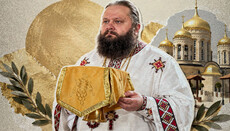
Metropolitan Pimen of Rivne and Ostroh celebrated a service at Gorny Convent in Jerusalem during a pilgrimage to the Holy Land. The convent belongs to the Russian Ecclesiastical Mission and is therefore under the jurisdiction of the Russian Orthodox Church. The Mission’s website reported on the service, and OCU-affiliated outlets immediately picked up the story and declared yet another act of “treason” – claiming that while Russia is killing Ukrainians, the head of a UOC eparchy in the Rivne region is serving “in a Moscow Patriarchate convent.”
One might think that would have been the end of the story – it was hardly worth making a fuss about. But soon afterward, the UOC’s Rivne Eparchy issued a statement that sounded more like a defense. It explained that the metropolitan had served at the invitation of Ukrainian sisters who have lived in the convent for more than twenty years; that he prayed at the request of mothers whose sons had been killed in the war; that the Mission’s website had presented the story “dishonestly and manipulatively”; and that Metropolitan Pimen is a Ukrainian patriot and spiritual shepherd of his Ukrainian flock.
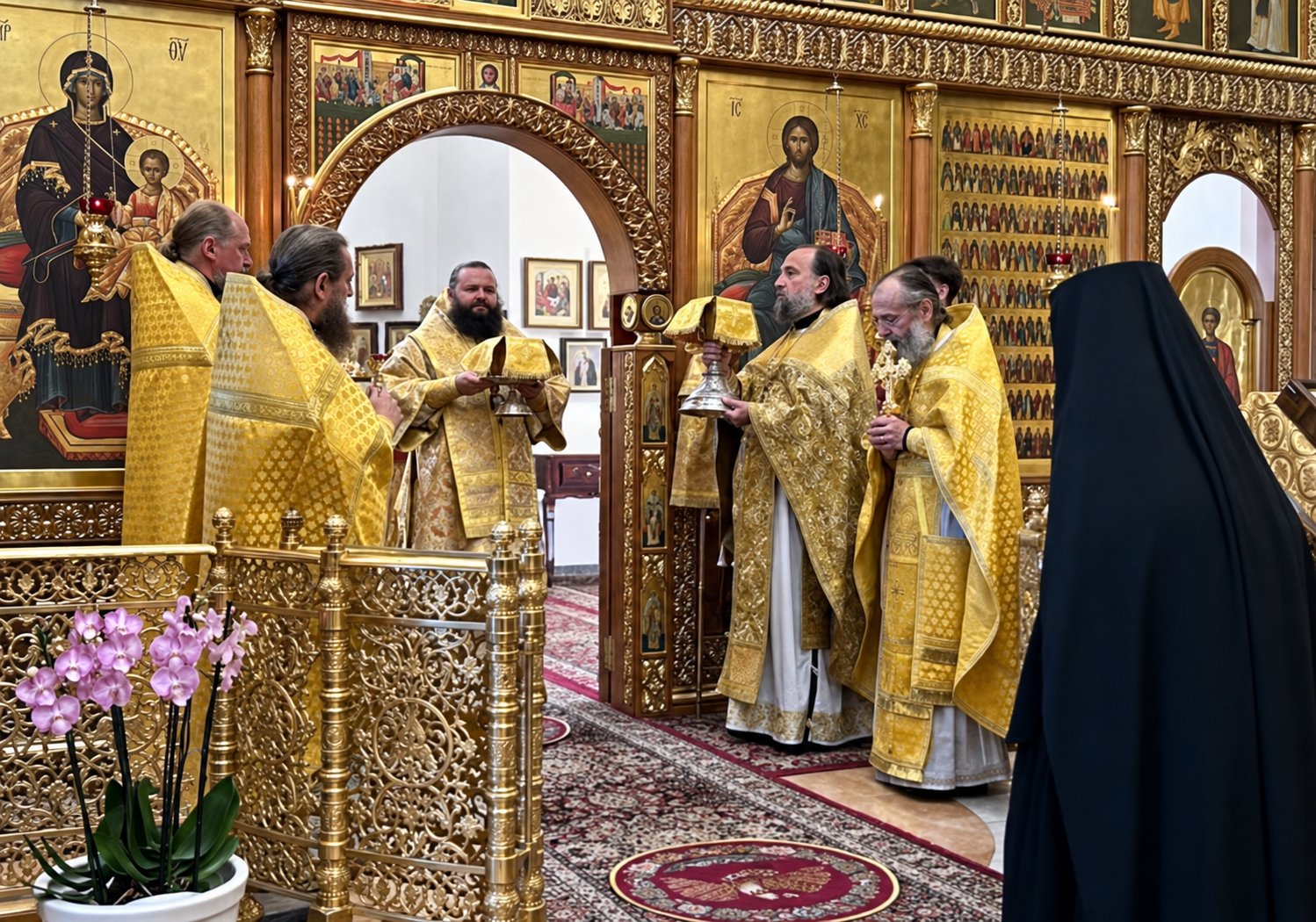
All of this is undoubtedly true. But it is still a defense – and a defense of something for which a Christian should never have to apologize: the Liturgy.
Consider for a moment: the Rivne Eparchy has explained itself – but what does it expect to accomplish? That the “patriots” will read the statement and say, “Oh, sorry, we didn’t know about the Ukrainian sisters. In that case, everything is fine”? They won’t. That OCU-affiliated outlets will stop calling the UOC “Moscow-linked”? They won’t. That DESS, whose entire campaign rests on the premise that “the UOC is part of the ROC,” will read the Rivne Eparchy’s press release and repent? That is hardly plausible.
The enemies of the Church do not need arguments – their views do not depend on arguments. What they need are apologies, because to them every apology is an admission of guilt. But once we admit guilt for celebrating the Liturgy, we open a door that will not be easy to close.
What exactly is the accusation?
Metropolitan Pimen did not speak in support of the “special military operation,” sign any declarations, pose for photographs with Russian officials, bless weapons, or speak about the “unity of Holy Rus.” If all the complaints voiced by the “patriots” are boiled down to their essence, the accusation is this: one must not pray in a church that is administratively subordinate to a Church headquartered in an aggressor state. Let us emphasize those words: “one must not pray.”
And this is where things become particularly interesting. Because if we accept this logic, we must also accept that a Liturgy can be “right” or “wrong” depending on jurisdiction – that a Sacrament that has existed for two thousand years is now defined not by belonging to the Church of Christ, but by national borders.
One Church, one Sacrifice
Orthodox ecclesiology – the Church’s teaching about itself – is perfectly clear: there is no separate Russian Church, Greek Church, Constantinopolitan Church, or Ukrainian Church. There is one Church of Christ, administratively divided into Local Churches but united in faith, in the Sacraments and, above all, in the Eucharist. Russian, Ukrainian, Serbian – these are not different Churches, but parts of a single whole.
Critics should also remember that the Bloodless Sacrifice offered at the Liturgy is the same everywhere. It is neither “Moscow” nor “Kyiv.” Christ is not more present on one altar than on another. This is precisely why the Church is called Catholic and Apostolic, rather than national or state-controlled.
This is not a theological abstraction but something recognized by all the Local Churches without exception. Despite war, breaks in communion, disputes between patriarchs, and mistakes by hierarchs, the Church continues to fulfill its mission – leading people to salvation.
Moreover, Patriarch Bartholomew, who regularly and sharply criticizes the ROC, has never questioned whether the bread and wine in Moscow Patriarchate churches become the Body and Blood of Christ. More than that – at every Liturgy he commemorates Patriarch Kirill and celebrates services for Istanbul’s Russian-speaking community. This deserves a closer look, because it is precisely here that the accusers’ entire argument falls apart.
The Phanar commemorates Patriarch Kirill
Let us start at the beginning. In the fall of 2018, Moscow broke Eucharistic communion with Constantinople over the process of establishing the OCU: on October 15, 2018, the ROC Synod prohibited its clergy from concelebrating with clergy of Constantinople and its laity from receiving Communion in churches of the Ecumenical Patriarchate. One might have expected Constantinople to respond with an equivalent rupture. It did not.
On October 19, 2018 – just four days later – the Archdiocese of Russian Orthodox Churches in Western Europe, then under the jurisdiction of Constantinople, issued an official statement telling the faithful that the Ecumenical Patriarchate had not broken communion with the Moscow Patriarchate and continued to commemorate it in the order established by the diptychs. In other words, from the very first days of the conflict, the Phanar made its position clear – a position it maintains to this day: the break in Eucharistic communion was a unilateral act by Moscow, while for Constantinople the ROC remains a canonical Church whose primate is commemorated at the patriarchal Liturgy.
In late October 2021, speaking before the Archons of the Ecumenical Patriarchate in the United States, Patriarch Bartholomew uttered a phrase worth remembering for everyone who now demands that the UOC repent for a Liturgy: “We continue to commemorate Patriarch Kirill as before.” He added that when the newly elected head of the OCU, Epifaniy, asked whether he should commemorate the Moscow Patriarch, Bartholomew told him yes – commemorate him just as you do all the other primates of the autocephalous Orthodox Churches.
This is a crucial point. Patriarch Bartholomew does not commemorate Patriarch Kirill by mistake or out of inertia. He does so deliberately, publicly explains his position, and expects the same from the head of the OCU. The logic is canonical: Patriarch Kirill is the lawful primate of a Local Church that occupies fifth place in the diptychs, and in the eyes of the Ecumenical Patriarchate his commemoration is a visible sign of the unity of the Orthodox Church.
And note this: after Patriarch Bartholomew said this, no one accused him of “treason.” No one said that commemorating Patriarch Kirill meant supporting the Kremlin. Why? Because everyone understands perfectly well that this is simply a matter of church order. That is all.
How Epifaniy commemorated Patriarch Kirill
Now to something the OCU is far less eager to remember.
On January 7, 2019, the day after receiving the Tomos, Epifaniy Dumenko celebrated the Christmas “liturgy” – and commemorated Patriarch Kirill in the diptychs. This so bewildered his own flock that OCU spokesman Yevstratiy Zoria had to explain. The Russian Church, he said, is one of the Local Churches and occupies fifth place in the diptychs. Its primate therefore had to be commemorated “since he has not been canonically condemned”: doing so was a testimony to the unity of the Church.
Read that again.
In the OCU’s own view, the Russian Church is a Local Church, its primate has not been canonically condemned, and commemorating him is necessary for the sake of Church unity. This was not the UOJ speaking, nor the UOC’s Rivne Eparchy, nor some alleged “Kremlin agents.” It was the OCU spokesman explaining the actions of his own leader.
There is more. On February 3, 2019, at his enthronement in St. Sophia Cathedral in Kyiv, Epifaniy again commemorated Patriarch Kirill. Once again, he explained why. In an interview with Sonia Koshkina, he said that before receiving the Tomos he had not commemorated Kirill because he was not bound by any legal requirements to do so, but that after receiving the Tomos he was obliged to commemorate him, since Patriarch Bartholomew did so and the Mother Church was the OCU’s model. Epifaniy said much the same thing in an interview with Radio Liberty, where he was even more explicit: the OCU sought recognition from the other Local Churches and therefore had to observe canonical order, “whether we like it or not.”
In other words, the head of the OCU openly acknowledged that commemorating Patriarch Kirill was a requirement of the Tomos, a matter of canonical order and the “price” of recognition. It was not a question of conscience or patriotism, but of church law.
It is also worth recalling what came before. Even before the Tomos, representatives of the “Kyiv Patriarchate” openly discussed the conditions under which they would commemorate the ROC Patriarch. Commemoration was treated as a bargaining chip – which in itself shows that the issue was political rather than one of faith.
After February 24: three weeks of silence
There is another detail the OCU prefers not to discuss. The full-scale war began on February 24, 2022. One might reasonably have expected Epifaniy to announce that very day that he would stop commemorating Kirill. But the public learned about it only on March 18 – three weeks after the invasion. And the news came not through a statement from the OCU “Synod” or a sermon by Epifaniy, but through a Facebook post by Yevstratiy Zoria. Zoria wrote that, for anyone who was interested and had “not yet noticed in the numerous YouTube broadcasts,” Epifaniy had removed the ROC primate’s name from the diptychs.
Zoria’s wording is revealing. “Anyone who has not yet noticed” means that few people had noticed. In other words, for three weeks of war, hardly anyone in the OCU was listening closely enough to the diptychs during broadcasts of its “services” to notice, demand explanations, or write about “treason.” Moreover, the OCU has no official documents on the matter – no decision by its “Synod,” no decision by its “Council,” not even an official statement from Dumenko. Because the OCU understands perfectly well that it has no right to disregard the Phanar’s instructions.
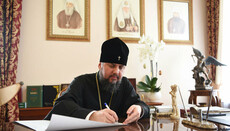
Moreover, after February 24, 2022, the OCU did not declare the ROC devoid of grace. On the contrary, in May 2022, Epifaniy appealed to Patriarch Bartholomew and the primates of the Local Churches, asking them to depose Patriarch Kirill over the “heretical teaching of the Russian world.” Note the logic of that appeal: the OCU is asking for Patriarch Kirill to be put on trial – and one can only put on trial someone who is a member of the Church. Thus, Epifaniy’s appeal itself acknowledges that Patriarch Kirill remains a canonically uncondemned primate of a canonical Church. Otherwise, what would there be to ask for?
Patriarch Kirill is commemorated at the Phanar in the presence of OCU clergy
Put all these facts together, and the picture becomes highly uncomfortable for the OCU.
Patriarch Bartholomew, by his own account, commemorates Patriarch Kirill “as before.” The primates listed in the diptychs are commemorated at every patriarchal Liturgy – this is not a one-off gesture but an established liturgical practice. Moreover, at patriarchal Liturgies at the Phanar, “Many years” is proclaimed for the ROC primate.
And that is not all. Whenever OCU clergy “concelebrate” or pray at a patriarchal Liturgy at the Phanar, they hear Patriarch Kirill being commemorated.
And they concelebrate regularly. On January 6, 2019, Epifaniy “concelebrated” with Patriarch Bartholomew at the Phanar during the presentation of the Tomos. In December 2019, an OCU hierarch “concelebrated” with Patriarchs Bartholomew and Theodoros in Istanbul. Particularly noteworthy is that on May 19, 2025, Yevstratiy Zoria “concelebrated” with Patriarch Bartholomew – more than three years after the beginning of the full-scale war.
So why did he not walk out of the church when he heard the name of the Moscow Patriarch? Why did he not interrupt the service, remove his vestments, or write an indignant post? Why did he not demand an explanation from Patriarch Bartholomew? No – he stood there, prayed, and “concelebrated” with the very Patriarch who prays for Patriarch Kirill. And he is not alone. Representatives of Ukraine’s diplomatic mission in Turkey also frequently attend services celebrated by the Ecumenical Patriarch. Has any of them protested that Patriarch Bartholomew commemorates Patriarch Kirill? We have heard of no such case.
That is precisely why we consider the accusation against Metropolitan Pimen simply absurd.
OCU clergy concelebrate with a Patriarch who commemorates Patriarch Kirill – and that is considered normal. A UOC metropolitan serves at a monastery administratively belonging to the ROC – and that is called treason. Can anyone explain the fundamental difference without resorting to the word “politics”?
The OCU itself recognizes the ROC as a canonical Church
But the argument does not end there. The OCU recognizes the ROC as a canonical Church not only through the words of Zoria and Epifaniy but through its actions – every time it receives another priest from the UOC into its ranks.
When a UOC cleric joins the OCU, no one ordains him again. He is not baptized again, chrismated again, or subjected to another ordination. He is received “in his existing rank,” meaning that the ordination he received in the UOC is recognized as valid and grace-filled. This was the case with Metropolitan Simeon (Shostatsky), with Metropolitan Oleksandr (Drabinko), and with every village priest who has joined the OCU voluntarily or under pressure.
At the same time, the OCU, the Ukrainian authorities, the media, and the “patriotic public” all insist that the UOC is “part of the ROC,” a “Moscow Church,” an “FSB branch,” and so on. The law targeting the UOC is built on this premise, as is the entire state examination of its affiliation.
But if the UOC is part of the ROC, then ordinations in the UOC are ROC ordinations. And if the OCU accepts those ordinations without repeating them, then it recognizes the ROC’s Sacraments as genuine, the grace in the ROC as genuine, and ROC hierarchs as genuine bishops rather than “priests in uniform.” Otherwise, everyone who joined the OCU would have to be ordained again, as is done with clergy coming from communities regarded as clearly devoid of sacramental grace.
The OCU’s argument therefore falls into two incompatible halves. Either the UOC is not part of the ROC, in which case all accusations that it is “Moscow-linked” are false and there is nothing to apologize for; or the UOC is part of the ROC, in which case the OCU itself recognizes the ROC’s sacramental grace and, consequently, prayer in its churches. There is no third option, because one cannot simultaneously recognize the ROC’s sacramental grace and declare that praying in one of its churches is a crime.
This argument shows that the accusations against the UOC are political rather than ecclesiastical in nature. And political accusations should not be answered with ecclesiastical apologies. They should be answered with a question: What does any of this have to do with faith?
Double standards that bother no one
If the principle that “one must not pray with a Church headquartered in an aggressor state” were applied consistently, its implications would be very broad indeed.
The Jerusalem Patriarchate, with which the UOC is in full Eucharistic communion and whose hierarchs concelebrated with Metropolitan Pimen during the same visit to Jerusalem, is itself in communion with the ROC. Patriarch Theophilos regularly receives Moscow Patriarchate delegations, serves with Russian hierarchs, and has not recognized the OCU. By the accusers’ logic, concelebrating with Jerusalem means concelebrating with those who maintain very close ties with Moscow. Yet for some reason, no one wrote a word about that.
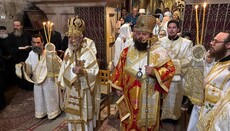
When Metropolitan Pimen served with Jerusalem hierarchs, the “patriotic public” remained silent. From the Church’s perspective, there is no difference between a Liturgy in the Jerusalem Patriarchate and a Liturgy at Gorny Convent: Christ was invisibly present at both. The difference exists only in the eyes of the “patriots.”
Georgia went through a war with Russia in 2008, and the Georgian Orthodox Church effectively lost the ability to minister to its flock in Abkhazia and South Ossetia. Yet it did not break Eucharistic communion with the ROC. Catholicos-Patriarch Ilia II traveled to Moscow after the war, served with Patriarch Kirill, and commemorated him in the diptychs. Georgian bishops were not branded traitors for praying with the Church of a country that occupies one-fifth of their territory.
The Serbian, Antiochian, Bulgarian, and Polish Churches, as well as the Church of the Czech Lands and Slovakia, are all in communion with the ROC. Athonite monasteries, including Greek ones, receive Russian pilgrims and serve with Russian priests. Even those Local Churches that have recognized the OCU have not, for their part, broken communion with Moscow – and no one treats that as a scandal.
How the cycle of apologies works
Now to the central point – why there should be no apology in this case.
There is a well-known concept in political science called the Overton window: what was unthinkable yesterday becomes debatable today, acceptable tomorrow, and mandatory the day after. The window shifts not through major concessions but through small steps. No one demands that Orthodox Christians renounce their faith all at once. They are asked to do it gradually: first to be ashamed of their traditions, then of their morality, and eventually of the faith itself. At every stage, explanations and apologies are demanded.
Recall that not so long ago the UOC was deemed “guilty” because it did not want to close its churches during the pandemic and move the Liturgy online. UOC hierarchs issued statements then as well, explaining that priests were observing all the required measures, that churches were being ventilated, and that Communion was safe. In essence, they were defending themselves. Did it help? No.
Then the UOC was “guilty” of commemorating Patriarch Kirill. It defended itself, explained the canonical nature of the commemoration, and cited its statutes. That did not help either. When the commemoration ceased, the accusations not only continued but intensified. Now the UOC is “guilty” because one of its hierarchs served at a monastery belonging to the ROC. What comes next?
The authorities are already suggesting that, for the sake of European integration, it might be appropriate to reconsider attitudes toward LGBT issues. Perhaps next they will suggest reconsidering attitudes toward abortion, suicide, “gender education,” or participation in “interfaith” prayers with anyone whatsoever. And every time Orthodox Christians will be told: You see, you already backed down last time, so apparently the principle was not so absolute after all.
By apologizing, we move the boundary ourselves. We acknowledge that we are required to account to the secular “public” for where and with whom we pray. But if we are obliged to answer for that, then what are we not obliged to answer for? If today a hierarch must prove that praying in an Orthodox monastery does not make him a traitor, will he tomorrow have to prove that simply praying does not make him one?
The Antichrist, whom the Church has known about since apostolic times, is unlikely to arrive with an outright ban on the Liturgy. He will come asking people to explain why they need it. And many will explain. Then they will explain why they can manage without it.
What could have been said instead of an apology
The statement by the UOC’s Rivne Eparchy is understandable on a human level. These people are in a difficult position: they face pressure from prosecutors, the SBU, local authorities, and “patriots.” They are trying to defend their hierarch and their flock. That is a noble impulse. But it is the wrong strategy, one that in the long run leads not to protection but to capitulation.
The response could have been entirely different. For example:
“Yes, Metropolitan Pimen celebrated the Liturgy at Gorny Convent in Jerusalem. Yes, the convent belongs to the Russian Orthodox Church. The UOC is in Eucharistic communion with it – just as it is with the Jerusalem, Antiochian, Serbian, Georgian, and other Local Churches. Patriarch Bartholomew commemorates the primate of the Russian Church at every patriarchal service and has publicly explained why. The Liturgy is not a political action or a statement of support for anyone. It is a Sacrament of the Church. It is prayer. Only someone who does not understand what the Church is – or who understands perfectly well but is deliberately manipulating the issue – could accuse a bishop simply for praying.”
Such a response certainly would not please the accusers. But nothing the UOC says will please them anyway. The difference is that a response like this leaves no room for the next accusation. An apology always does.
The Church does not have to apologize for being the Church. It has its canons, two thousand years of life in God, and its teaching on the unity of the Body of Christ. And it has a simple truth that every believer can understand: Christ is one – and He is the same on every altar, in Kyiv and Jerusalem, in Moscow and Istanbul. Anyone who demands that Orthodox Christians be ashamed of that unity is demanding not patriotism, but renunciation. And, as always, it begins with something small – repentance for the “wrong” Liturgy.